

Social Media Marketing vs Digital Marketing: What's the Difference?
February 18, 2026
8

If you have ever sat in a meeting where someone used "social media marketing" and "digital marketing" interchangeably, you are not alone. It happens constantly, and honestly, it makes sense why people mix them up. Both involve screens, both involve content, and both are supposed to bring in customers. But treating them as the same thing is like calling a wheel the same as a car. One is part of the other, not the other way around.
This post is going to clear that up once and for all, in plain language, without burying you in jargon.
What Is Digital Marketing, Actually?
Digital marketing is the broad umbrella term for any marketing activity that happens online or through digital channels. That includes search engines, websites, email, paid ads, mobile apps, content marketing, and yes, social media too.
Think of digital marketing as the entire playing field. It covers every touchpoint a potential customer might have with your brand in the digital world, from the moment they type a search query into Google, to the moment they click "buy now" on your product page.
The Main Channels Under Digital Marketing
To understand how wide this umbrella is, here is a quick look at what falls under digital marketing:
Search Engine Optimization (SEO): Getting your website to rank on Google and other search engines organically, without paying for each click.
Pay-Per-Click Advertising (PPC): Running paid ads on Google, Bing, or other platforms where you pay each time someone clicks.
Email Marketing: Building a list and sending targeted messages directly to people's inboxes.
Content Marketing: Creating blog posts, videos, podcasts, guides, and other content that attracts and educates your audience.
Affiliate Marketing: Partnering with other websites or creators who promote your product in exchange for a commission.
Social Media Marketing: Yes, this one lives here too, as one piece of the larger digital puzzle.
Each of these channels requires a different skill set, a different budget, and a different strategy. A business that only focuses on social media is leaving a significant portion of the digital landscape untouched.
If you are unsure which digital channels make the most sense for your business right now, the team at Foxtale Media can help you build a strategy that actually fits your goals. You can explore what they offer at foxtalemedia.com/services.
What Is Social Media Marketing?
Social media marketing is exactly what it sounds like: using social media platforms to promote your brand, build an audience, drive traffic, and generate leads or sales.
The platforms most commonly used include Instagram, Facebook, LinkedIn, YouTube, X (formerly Twitter), Pinterest, and increasingly, platforms like Threads. Each platform has its own culture, its own algorithm, and its own content format that tends to perform well.
What Social Media Marketing Actually Involves
Social media marketing goes beyond just posting pretty pictures. Done properly, it includes:
Content creation and scheduling: Planning and producing posts, reels, carousels, stories, and videos consistently.
Community management: Responding to comments, messages, and mentions in a way that builds trust and loyalty.
Influencer partnerships: Collaborating with creators who already have the attention of your target audience.
Paid social advertising: Running targeted ad campaigns on platforms like Meta Ads Manager or LinkedIn Campaign Manager.
Analytics and reporting: Tracking what content performs, what falls flat, and adjusting accordingly.
Social media marketing is a real discipline on its own. It takes time, creativity, consistency, and data literacy to do it well. But it is still just one department inside the larger building that is digital marketing.
The Core Difference: One Is Part of the Other
Here is the simplest way to think about it:
All social media marketing is digital marketing. But not all digital marketing is social media marketing.
Social media marketing lives within the digital marketing ecosystem. If your brand is only active on Instagram and Facebook but has no SEO strategy, no email list, and no paid search presence, you have a social media strategy, not a complete digital marketing strategy.
This distinction matters enormously when you are deciding where to invest your time and budget. A small business owner who spends hours every day on Instagram content might be missing out on SEO-driven traffic that would convert at a much higher rate. On the flip side, a company that invests heavily in Google Ads but has zero social presence might struggle with brand awareness and trust signals.
The best results tend to come from a blended approach where social media plays a role alongside other digital channels, not instead of them.
Why Businesses Get This Wrong
A lot of businesses, especially smaller ones, fall into the trap of treating social media as their entire marketing strategy. There are a few reasons this happens:
Social media is visible and feels immediate. When you post something and get likes and comments, it feels like marketing is working. The feedback loop is fast. Compare that to SEO, which can take months to show results, and it is easy to see why business owners gravitate toward social.
Social media is relatively accessible. You do not need a developer or a big agency to create an Instagram account and start posting. The low barrier to entry makes it the default starting point for most businesses.
The platforms themselves encourage constant use. Meta, LinkedIn, and others have built products designed to keep you posting, engaging, and running ads. They have a vested interest in making social media feel like the most important marketing channel.
None of this means social media is wrong to invest in. It just means you have to understand its limitations and see it as one component of a wider strategy.
When to Prioritize Social Media Marketing
There are absolutely situations where leaning heavily into social media makes sense, at least in the short term.
You are building brand awareness from scratch
If you are a new business and nobody knows you exist yet, social media can be one of the fastest ways to get visible. It lets you show your brand personality, build a community, and start conversations without a huge budget.
Your audience is highly active on specific platforms
If your target customers spend a significant amount of time on Instagram or LinkedIn, you need to be there. Meeting your audience where they already are is a foundational marketing principle, and social media makes that possible.
You sell visually driven products or services
If you are a fashion brand, a food business, a travel company, or any other business where visuals do the heavy lifting, platforms like Instagram and Pinterest can drive genuine buying intent.
You want to build long-term relationships
Social media is one of the few channels where ongoing, two-way conversation is the norm. If building community and customer loyalty is a priority, social platforms offer tools that email and SEO simply cannot replicate in the same way.
When to Prioritize a Broader Digital Marketing Strategy
Social media alone will not cut it in every scenario. Here are situations where thinking beyond social becomes critical.
You need predictable, scalable traffic
SEO and paid search can deliver traffic that is more intent-driven than most social media channels. Someone searching "best accounting software for freelancers" is further along in the buying journey than someone who stumbles across your post in their feed.
You are in a niche B2B market
If you sell software to HR departments or equipment to manufacturing companies, Instagram is probably not where your next customer is making their decisions. A combination of LinkedIn marketing, content marketing, email nurturing, and Google Ads is likely to serve you far better.
You want to own your audience
Social media platforms can change their algorithms overnight, restrict your reach, or even shut down accounts. Email lists and SEO traffic are assets you control. A well-rounded digital marketing strategy builds channels that you own alongside those you rent.
You need measurable ROI
While social media analytics have improved considerably, attributing direct revenue to a specific Instagram post is still messy. Digital marketing channels like email and paid search often offer cleaner attribution data, making it easier to see what is actually driving results.
If you are at the point where you want to build out a full digital marketing strategy, rather than just a social media presence, it is worth talking to people who understand how all the pieces fit together. Foxtale Media works with businesses across different industries to design integrated strategies that go beyond the feed. See what that looks like at foxtalemedia.com/services.
How They Work Together
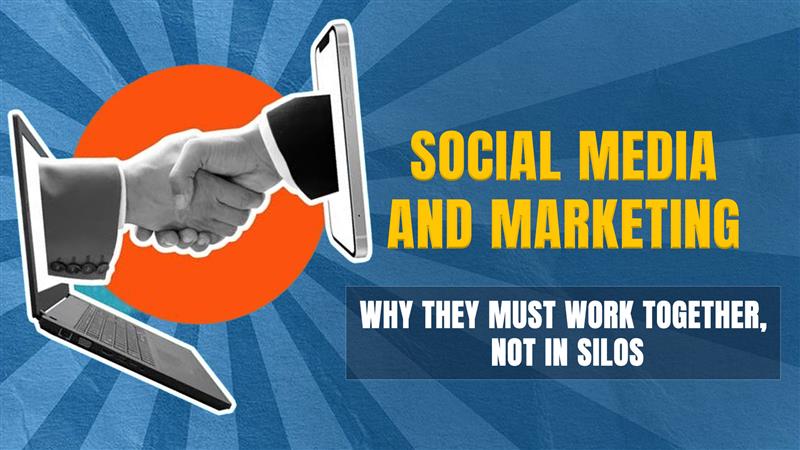
Here is where things get interesting. Social media marketing and the broader digital marketing ecosystem do not compete. They complement each other, often in very direct ways.
Your blog content (content marketing) gets shared on social media, driving traffic back to your website. That website traffic helps your SEO. Your email subscribers share your content on their social profiles, growing your audience organically. Your social media ads retarget people who visited your website through Google search. Every channel feeds the others.
This is why marketers who understand digital marketing holistically tend to get better results than those who hyper-focus on one channel in isolation. They see the connections between what they are doing on Instagram and what is happening on their website and in their email reports.
A Real-World Example
Imagine a local bakery trying to grow its business. A social-media-only approach might involve posting daily on Instagram, running a few Meta ads, and building a following. That can work to a point.
But a digital marketing approach would layer in a Google Business Profile optimized for local SEO, a website with a blog covering topics like "best custom cakes in [city]," an email list for loyal customers, and retargeting ads for people who visit the site but do not place an order. Social media is part of the mix, but it is not carrying everything alone.
The bakery with the integrated strategy is going to grow faster and more sustainably.
The Bottom Line
Social media marketing is a powerful, valuable, and often underutilized tool. But it is one tool inside a much larger toolbox called digital marketing.
If someone tells you that social media is all you need, or conversely that it does not matter at all, both are oversimplifications. The truth is that your business needs a strategy that fits your audience, your industry, your budget, and your goals. That strategy will almost certainly include social media. It should also include a few other things.
Understanding the difference between these two terms is not just a vocabulary exercise. It is the foundation for making smarter decisions about where to put your time and money.
If you are ready to stop guessing and start building a marketing approach that actually covers your bases, Foxtale Media offers services designed to help businesses do exactly that. From social media to full-scale digital strategy, you can find out more at foxtalemedia.com/services.
Related Blog
.jpg)
February 21, 2026
8
What Is Networking in Marketing? And Why It Still Wins in a Digital World
February 3, 2026
8
%201.svg)